Center for Surgical Excellence
Advanced HPB Surgery:
Liver, Pancreas & Bile Ducts
Hepato-Pancreato-Biliary (HPB) surgery focuses on the body's most complex organs. Treating tumors and cysts in the Liver, Pancreas, and Biliary system requires extreme precision, as these organs are wrapped around the body's most vital blood vessels. We combine robotic technology with high-volume surgical expertise.
The Vital Organs
Most patients are confused about the "HPB" system. Think of it as a factory and plumbing system working together:
The Liver (Factory)
Filters blood and manufactures bile. It is the only organ that can regenerate.
The Pancreas (Chemist)
Creates enzymes for digestion and insulin for sugar control. Sits deep behind the stomach.
⚠️ The Warning Signs
Jaundice
Weight Loss
Dark Urine
Severe Itch
Clay Stools
Back Pain
The Detective Work
Before we cut, we must see. We map the tumor with precision to ensure it is removable.
Surgeon's Insight: No Biopsy?
Patients often ask, "Why didn't you biopsy the liver tumor?" Answer: Poking a liver or bile duct cancer with a needle can spread it. If the Triphasic CT scan pattern is clear, we go straight to surgery to remove it safely.
- Triphasic CT Scan: Takes pictures at specific seconds (arterial/venous phases) to identify cancer types.
- MRCP: An MRI that creates a 3D roadmap of your bile ducts without any needles.
- PET Scan: Makes active cancer cells "light up" to ensure there is no distant spread.
Complex Gallbladder & Biliary
Not all gallbladder surgeries are simple stones. We specialize in difficult conditions that mimic cancer and actual malignancies.
XGC (Xanthogranulomatous Cholecystitis)
The "Wolf in Sheep's Clothing."
This is a rare, benign condition where the gallbladder becomes rock-hard and excessively inflamed, mimicking cancer on scans. It sticks tightly to the liver and intestines.
The Surgery: It requires an expert "Difficult Cholecystectomy." We often use a frozen section (instant biopsy) during surgery to confirm it isn't cancer before carefully peeling it off vital structures.
Gallbladder Cancer
Common in North India, often mistaken for simple stones. A simple removal is not enough and can be dangerous.
The Surgery: Radical Cholecystectomy
We perform a wide excision. This involves removing the gallbladder, a wedge of the liver (Segments 4b & 5) attached to it, and clearing all the lymph nodes around the portal vein to prevent recurrence.
Bile Duct Cancer (Cholangiocarcinoma)
Cancer can grow inside the bile pipes (ducts). The surgery depends on the location:
- Upper Duct (Hilar): Requires major liver resection + bile duct removal.
- Lower Duct: Requires a Whipple Procedure.
- Reconstruction: In all cases, we rebuild the plumbing by bringing a loop of intestine up to the liver (Hepatico-Jejunostomy).
Major Surgeries
The Whipple Procedure
Used for Pancreatic Head Cancer. It is a 6-hour surgery involving the removal of the pancreatic head, duodenum, gallbladder, and bile duct.
3 Reconstructions: After removal, we must reconnect the system:
- Pancreas to Intestine (Pancreatico-jejunostomy)
- Bile Duct to Intestine (Hepatico-jejunostomy)
- Stomach to Intestine (Gastro-jejunostomy)
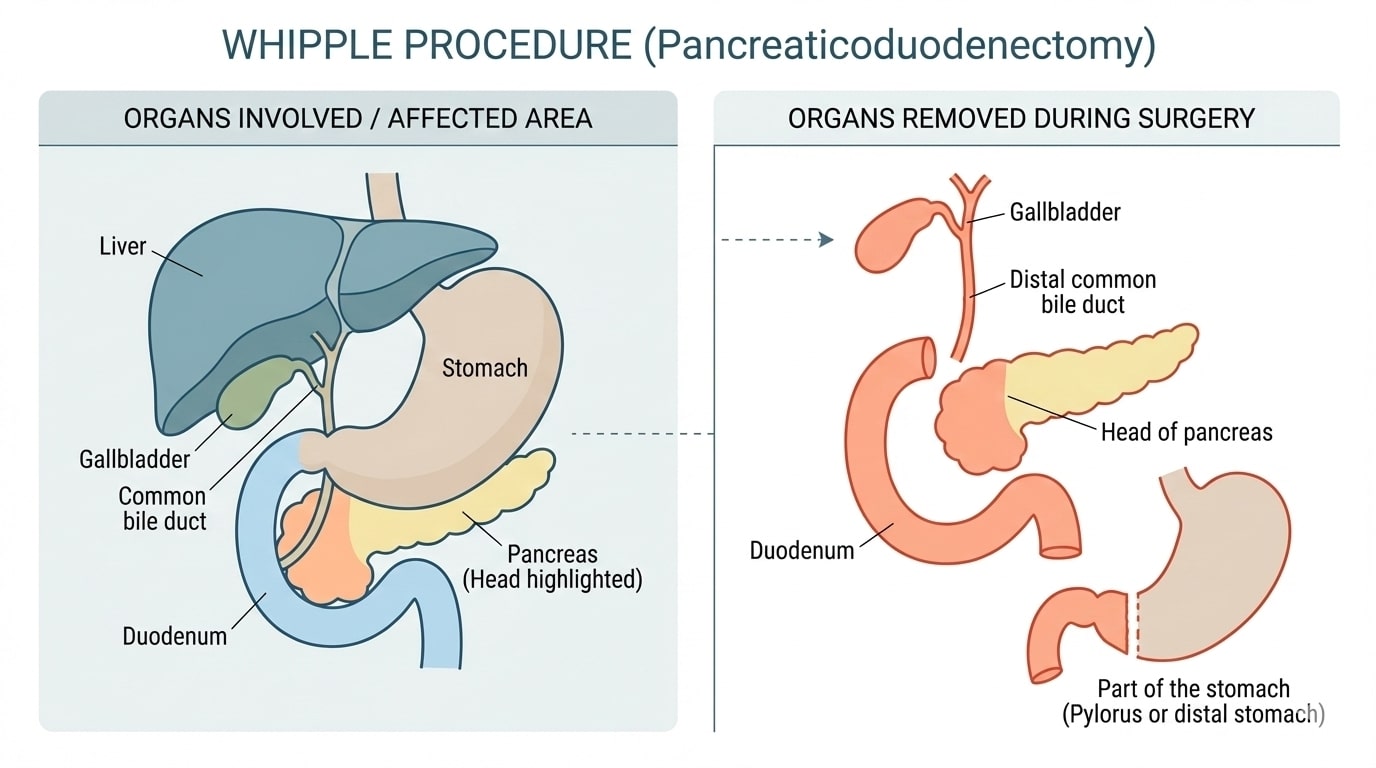
Anatomy of a Whipple Procedure: The "Grand" Surgery of the Abdomen
Liver Resection
We use CUSA Technology (Ultrasonic Aspirator) to dissolve liver cells while preserving blood vessels, allowing for bloodless removal of tumors.
Robotic Surgery
For distal pancreatectomy and liver cysts, we use the robot for 3D vision, tremor filtration, and tiny incisions.
Life After Surgery (ERAS)
We follow Enhanced Recovery After Surgery (ERAS) protocols. The goal is to get you home to your family, not keep you in the ICU.
Day 0 (Surgery Day)
You drink liquids 4 hours after surgery. Nutrition heals the gut.
Day 1
You walk out of bed. Movement prevents pneumonia and clots.
Life at Home: Diet & Surveillance
Discharge is not the end of the journey. We monitor you for years to ensure the best quality of life.
Can I Eat Normally?
Yes, mostly. Without a gallbladder, your body cannot store bile, so very fatty meals might cause loose stools initially. We recommend small, frequent meals for the first 4 weeks.
Pancreatic Enzymes
After Whipple surgery, your body may make fewer enzymes. We prescribe Creon capsules to be taken with meals to help you digest food and prevent weight loss.
The Cancer Watch (Surveillance)
We do not just perform surgery and say goodbye. Our protocol includes:
- Year 1-2: Review every 3 months.
- Year 3-5: Review every 6 months.
- Blood Tests: CA 19-9 and CEA markers checked at every visit.