
Best Hepatologist & Liver Specialist in Bangalore
If you are searching for a liver doctor near you in Bangalore, you have found the right place. Dr. Srinivas Bojanapu provides precision hepatology at Dhaara Liver Clinic, Yelahanka (North Bangalore) and Kauvery Hospital, Electronic City (South Bangalore) — moving beyond routine blood tests to reverse fatty liver, cure Hepatitis C, prevent liver cancer, and manage cirrhosis with the full weight of evidence-based medicine.
Weighing approximately 1.5 kilograms, your liver silently performs over 500 distinct biochemical functions every second of every day. It synthesises clotting factors, metabolises medications, detoxifies ammonia, conjugates bilirubin, stores glycogen, and orchestrates the entire fat-processing machinery of the human body. When it fails, every other organ follows.
Why You Need a Hepatologist, Not Just a GP
General physicians see the liver as one part of a system. A Hepatologist sees it as the centre of your health. A Gastroenterologist manages the alimentary canal. A Hepatologist is singularly devoted to the liver, biliary tree, and portal circulation. The distinction is not semantic; it is clinical.
The liver is the only visceral organ with a dual blood supply — 75% portal venous and 25% hepatic arterial — which creates disease patterns unique to hepatology. Portal hypertension, a state where pressure in the portal vein exceeds 10 mmHg, produces life-threatening complications: oesophageal varices, ascites, hepatic encephalopathy, and spontaneous bacterial peritonitis.
The Silent Killer Reality
80% of liver damage has NO symptoms. Patients often say, "But I feel fine." By the time jaundice appears, the window for easy reversal has often closed. Research confirms patients diagnosed at compensated cirrhosis stage have a 5-year survival exceeding 80%, compared to under 20% in decompensated disease.
Proactive Early Detection
Our practice is built on early detection using technology that sees what eyes cannot. We use Fibroscan elastography, advanced serum panels, and genetic profiling to catch liver disease at a stage when reversal is still possible — long before symptoms ever appear.
Precision Liver Diagnostics — The Truth Is In The Data
Standard ultrasounds are subjective and operator-dependent — notorious for under-staging fatty liver and missing early fibrosis. Our diagnostic approach relies on physics and biochemistry. We use Elastography to measure liver stiffness in Kilopascals (kPa), a value tied directly to fibrosis staging validated by biopsy-correlation studies in over 50,000 patients.
The clinical gold standard. A 5-minute, painless vibration pulse travels through the liver; its propagation speed correlates directly with stiffness. The Controlled Attenuation Parameter (CAP) simultaneously measures fat content — giving both a fibrosis score (kPa) and steatosis score (dB/m) in a single session.
We screen for the PNPLA3 rs738409 (I148M) variant — conferring 3.24× increased risk of hepatic steatosis — and the TM6SF2 E167K variant, associated with more severe NASH and faster fibrosis progression. Your genetic landscape determines personalised surveillance interval.
The FIB-4 index (age, AST, ALT, platelet count) is validated as a first-line triage tool. FIB-4 below 1.3 reliably excludes advanced fibrosis (NPV 90%). The Enhanced Liver Fibrosis (ELF) panel adds further precision for intermediate cases.
Fibrosis Staging: What Your Fibroscan Score Means
| Stage | Histology | Fibroscan kPa | Clinical Implication |
|---|---|---|---|
| F0 | No fibrosis | < 5.0 kPa | Annual surveillance; lifestyle modification |
| F1 | Mild periportal fibrosis | 5.0–7.0 kPa | 6-monthly review; treat underlying cause |
| F2 | Periportal bridging fibrosis | 7.0–9.5 kPa | Active pharmacotherapy; endoscopy considered |
| F3 | Bridging fibrosis | 9.5–12.5 kPa | Variceal screening; HCC surveillance initiated |
| F4 | Cirrhosis | > 12.5 kPa | 6-monthly AFP + ultrasound; transplant evaluation |
Beyond Fibroscan: Advanced Liver Imaging
When Fibroscan alone is insufficient — due to obesity, ascites, or suspected hepatic mass — we deploy advanced cross-sectional imaging for a precise anatomical and functional map of the liver.
MR Elastography (MRE)
The most accurate non-invasive fibrosis staging tool. Uses mechanical shear waves combined with MRI phase-contrast imaging to generate a stiffness map of the entire liver. AUROC 0.93 for advanced fibrosis — superior to every other non-invasive method currently available.
Shear Wave Elastography
Integrated into high-resolution ultrasound for real-time stiffness measurement during imaging. Particularly valuable for patients with BMI above 30. 2D-SWE provides colour-coded stiffness mapping of focal lesions, distinguishing benign haemangiomas from malignant nodules.
Multiparametric MRI
Combines T1 mapping, T2*, PDFF, and gadoxetic acid-enhanced sequences to simultaneously quantify liver fat, iron, fibrosis, and perfusion — the closest non-biopsy equivalent to a liver biopsy.
LI-RADS Hepatobiliary MRI
For suspicious focal lesions, LI-RADS standardised protocols using gadoxetic acid allow confident characterisation of hepatocellular carcinoma versus regenerative nodules — guiding treatment decisions with precision.
A meta-analysis in Hepatology (2021) evaluating 37 cohort studies found that combining FIB-4 with Fibroscan correctly reclassified 83% of patients who would have been sent for liver biopsy — avoiding an invasive procedure and cutting diagnostic costs by over 60%.
Fatty Liver Disease (MASLD / NASH) — Diagnosis & Reversal in Bangalore
Metabolic Dysfunction-Associated Steatotic Liver Disease (MASLD) affects 38% of the global adult population. In India, urban surveys suggest a prevalence of 32–40%, with rates rising sharply in patients with type 2 diabetes (up to 70%). The good news: MASLD is the only common liver disease with a proven pathway to complete histological reversal.
Approximately 25% of MASLD patients in Asia are non-obese — "lean NAFLD." These individuals have visceral adiposity disproportionate to their BMI, driven by genetic susceptibility and insulin resistance. We assess waist circumference and waist-to-height ratio, not just BMI, in every patient.
Evidence-Based 6-Step Reversal Protocol
Our structured programme combines pharmacotherapy, diet, and lifestyle to achieve NASH resolution in up to 58% of patients.
Pharmacotherapy
Saroglitazar (PPAR-α/γ dual agonist — only approved drug in India for NASH with fibrosis), Vitamin E 800 IU/day (PIVENS trial), and GLP-1 receptor agonists (semaglutide — 39% NASH resolution vs 9% placebo).
Fructose & Liquid Sugar Elimination
100% of dietary fructose is captured by the liver on first pass, driving de novo lipogenesis. A single 500ml soft drink delivers 55g of high-fructose corn syrup — a direct hepatic fat injection.
10% Body Weight Reduction
A sustained 10% reduction in total body weight produces NASH resolution in 58% of patients and fibrosis regression in 40% — by reducing visceral adipose tissue, the primary source of pro-inflammatory adipokines.
3 Cups of Black Coffee Daily
Three or more cups daily is independently associated with a 40% reduction in liver stiffness progression in MASLD patients. Kahweol and cafestol are direct anti-fibrotic diterpenes. This is pharmacology in a cup.
Resistance Training
Progressive resistance exercise reduces intrahepatic fat by 13.7% independent of weight loss. Muscle tissue acts as a glucose sink, reducing hepatic glucose delivery and de novo lipogenesis.
Time-Restricted Eating (16:8)
A 16:8 eating window activates autophagy through the AMPK/mTOR pathway. A randomised pilot showed a 3.5% reduction in liver fat fraction on MRI after 3 months, without caloric counting.
Liver-Friendly Nutrition: Fuelling Recovery
Diet is not merely restriction — it is the provision of precise biochemical substrates for hepatocellular repair, mitochondrial biogenesis, and fibrosis resolution.
The Mediterranean Diet
The PREDIMED-Plus trial demonstrated Mediterranean diet adherence reduced liver fat by 1.5 percentage points on MRI-PDFF over 12 months. Extra-virgin olive oil, oily fish, legumes, and walnuts are the key pillars.
The Hepatotoxic Foods List
Beyond alcohol and fructose: processed red meat, aflatoxin-contaminated groundnuts (a major HCC risk factor in India), and trans fatty acids (vanaspati, margarine, commercially fried snacks) all activate hepatic inflammatory pathways.
Omega-3 Fatty Acids
EPA and DHA reduce hepatic SREBP-1c activity, cutting de novo lipogenesis. A Cochrane review of 10 RCTs found omega-3 supplementation (2–4g daily) significantly reduced liver fat on imaging versus placebo.
Gut Microbiome Nutrition
The gut–liver axis is central to MASLD pathogenesis. Prebiotic fibres (inulin, FOS) and probiotic fermented foods (unsweetened curd, homemade pickle, kefir) restore microbial diversity and reduce portal endotoxaemia.
Viral Hepatitis Treatment in Bangalore — B, C, A & E
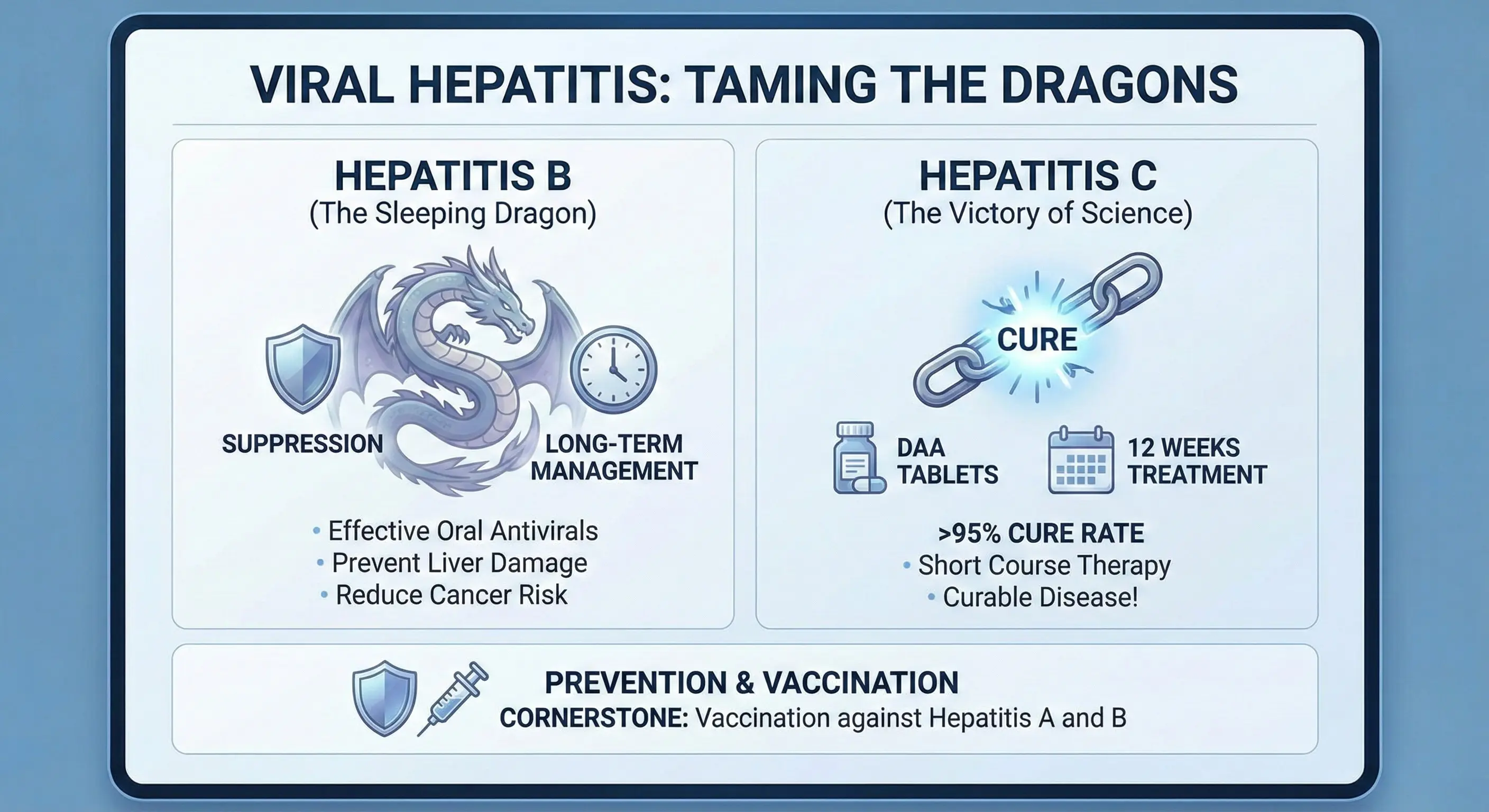
Hepatitis B: Suppressing the Dragon
HBV infects 296 million people worldwide and causes 820,000 deaths annually. Using Tenofovir Alafenamide (TAF) or TDF as first-line therapy, we suppress viral DNA to undetectable levels, halting fibrosis progression and reducing annual HCC incidence from 2–4% to under 0.5%.
Hepatitis C: A Complete Cure in 8–12 Weeks
With Direct Acting Antivirals — glecaprevir/pibrentasvir or sofosbuvir/velpatasvir — we achieve SVR rates of 95–99%. No injections. No interferon. In India, generic combinations have reduced complete treatment cost to under ₹25,000.
HBV reactivation — a potentially fatal hepatic flare — can occur when immunosuppressive therapy is initiated. All patients starting immunosuppression must be screened for HBsAg and anti-HBc before starting treatment. This is a preventable death that still occurs due to failure of pre-treatment screening.
Cirrhosis Management — Preventing Decompensation
Compensated cirrhosis carries a median survival exceeding 12 years. Decompensated cirrhosis carries a 2-year mortality of 50%. The hepatologist's singular goal is preventing this transition.
The Cirrhosis Management Protocol
A two-pillar approach: strict avoidance of hepatotoxic triggers and a structured surveillance and treatment programme.
The Absolute Forbidden List
NO Alcohol — even trace amounts accelerate fibrosis. NO NSAIDs — precipitate hepatorenal syndrome. NO Raw Seafood — Vibrio vulnificus mortality in cirrhotics exceeds 60%. NO unapproved Herbal Supplements — pyrrolizidine alkaloids cause sinusoidal obstruction syndrome.
The Survival Protocol
Vaccination — Annual flu, pneumococcal, HBV, HAV. High Protein Diet — 1.2–1.5g/kg/day; late-evening snack mandatory. 6-Monthly HCC Surveillance — Ultrasound + AFP reduces cancer mortality 37%. Rifaximin 550mg BD — Reduces encephalopathy hospitalisation 58%.
Portal Hypertension Management
Carvedilol is now preferred over propranolol as first-line prophylaxis for medium and large varices. Acute variceal haemorrhage carries 6-week mortality of 15–20% — managed by vasoactive therapy, antibiotic prophylaxis, and urgent endoscopic variceal band ligation within 12 hours.
Refractory Complications
Refractory variceal haemorrhage requires transjugular intrahepatic portosystemic shunt (TIPS) within 72 hours. Refractory ascites is managed with serial large-volume paracentesis with albumin replacement and consideration of TIPS or transplant listing.
Liver Cancer (HCC) — Detection & Management in Bangalore
Hepatocellular carcinoma is responsible for approximately 830,000 deaths annually. The critical determinant of outcome is stage at diagnosis: patients diagnosed at very early stage achieve 5-year survival exceeding 70%, while those at advanced stage face median survival of 14–21 months.
First-Line Systemic Therapy
The approval of atezolizumab + bevacizumab (IMbrave150 trial) has extended median overall survival to 19.2 months, surpassing sorafenib for the first time. Locoregional therapies — TACE, TARE (Y-90), and SBRT — have created bridge-to-transplant pathways.
HCC Can Occur Without Cirrhosis
20–30% of MASLD-associated HCC occurs in the non-cirrhotic liver. Our practice extends semi-annual ultrasound surveillance to high-risk MASLD patients with significant fibrosis, chronic HBV carriers, and first-degree relatives of HCC patients.
Alcohol-Related Liver Disease — The Full Spectrum
Alcohol-related liver disease encompasses a spectrum from simple steatosis (reversible within weeks of abstinence) through alcohol-related hepatitis to cirrhosis and HCC. The threshold for hepatotoxic consumption is lower than most patients believe: 21 units per week in men and 14 in women carries significant fibrogenic risk.
Severe alcohol-related hepatitis — Maddrey Discriminant Function ≥ 32 or MELD ≥ 20 — carries 28-day mortality of 20–40%. Prednisolone 40mg daily for 28 days, guided by a Lille score at day 7, remains the cornerstone of therapy. Long-term outcome is determined by sustained abstinence — the single most powerful intervention in ALD management.
Liver Disease Prevention — Four Pillars of Defence
The overwhelming majority of liver diseases are preventable or significantly delayable through targeted primary and secondary prevention.
Vaccination
Hepatitis B vaccination provides lifelong immunity in 95% of healthy adults. HBV vaccination programmes in Taiwan reduced HCC incidence by 75% over 25 years — the world's most cost-effective cancer prevention intervention. Hepatitis A two-dose vaccination provides lifelong protection.
Alcohol Limits
If you have fatty liver, the safe limit is zero. The synergistic hepatotoxicity of alcohol and steatosis accelerates fibrosis through complementary oxidative stress pathways. For those without existing liver disease, below 14 units/week (men) and 7 units (women) is the evidence-based threshold.
Metabolic Health
Maintain BMI below 25 kg/m² and waist circumference below 90cm (men) / 80cm (women) per IDF criteria for South Asian adults. Treating type 2 diabetes aggressively (target HbA1c below 7.0%) significantly reduces hepatic fat.
Hygiene & Food Safety
Hepatitis A and E are faeco-oral viruses. Boil or RO-filter drinking water; avoid raw shellfish and street food during monsoon; wash hands before meals. Store groundnuts, maize, and spices in cool, dry conditions to prevent aflatoxin contamination.
Anti-tuberculosis drugs cause hepatotoxicity in 5–28% of patients. Herbal and dietary supplements — including green tea extract, kava, and multiple Ayurvedic formulations — account for a rapidly increasing proportion of cases. Always disclose every supplement and herbal preparation to your hepatologist, without exception.