
Stomach Cancer & Robotic Surgery
Early diagnosis is the key to cure. Stomach (Gastric) cancer often mimics simple acidity, leading to delayed diagnosis. Dr. Srinivas Bojanapu leads a specialized unit focused on Radical Gastrectomy with D2 Lymphadenectomy—the global gold standard for cure. We use robotic precision to remove the cancer completely while ensuring you can eat and live normally afterward.
Acidity or Cancer? When to Worry
Most stomach cancers start with vague symptoms. It is a myth that cancer always causes pain. Early cancer is often painless. If "Gas" or "Acidity" persists for more than 4 weeks despite medication, especially if you are over 45, an Endoscopy is mandatory.
🚨 Red Flag Symptoms
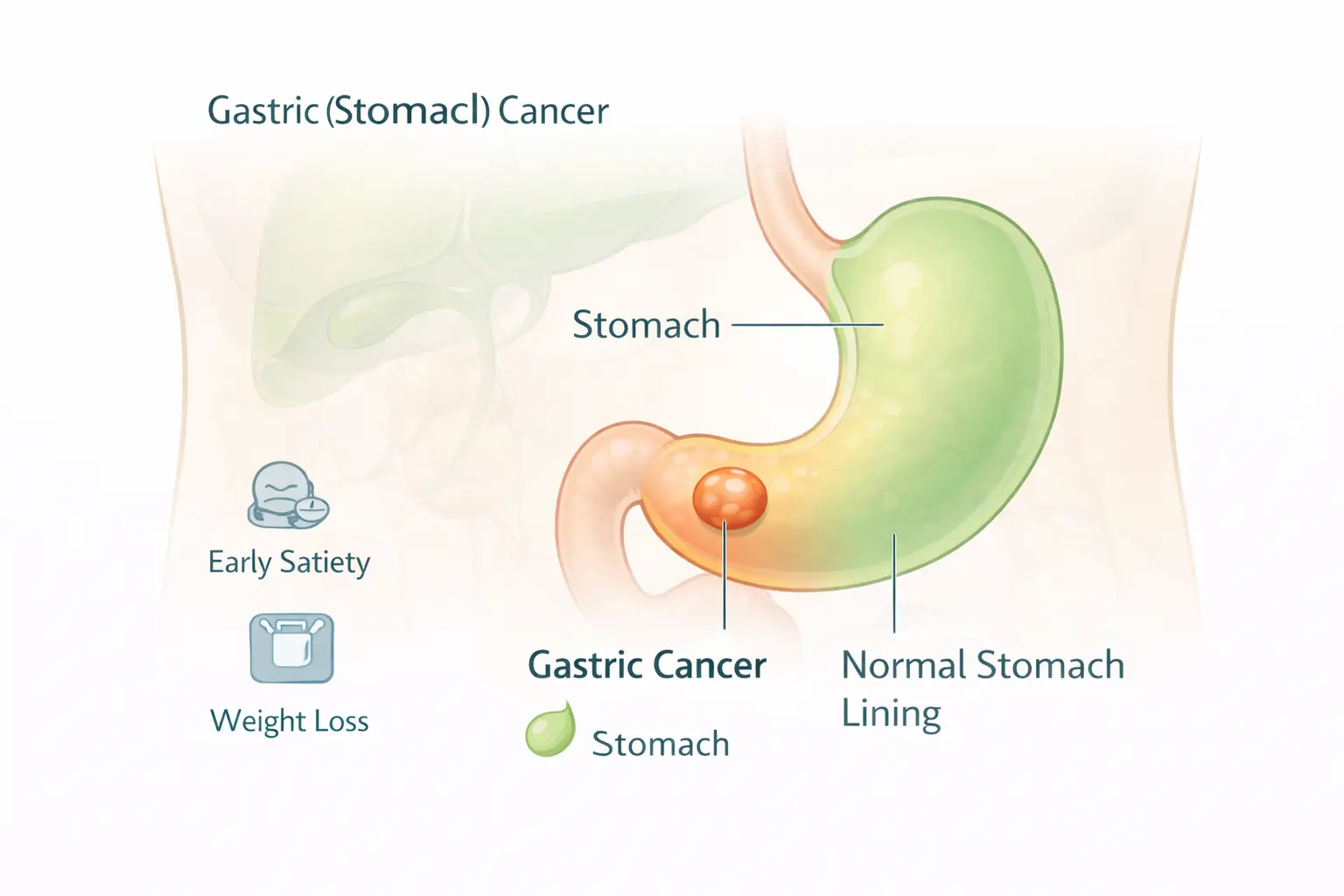
- Unexplained Weight Loss: Losing >5kg without trying.
- Early Satiety: Feeling "full" after eating just a few bites.
- Difficulty Swallowing: Food getting stuck in the chest (Dysphagia).
- Black Stools: Indicates bleeding from the tumor (Melena).
The Diagnostic Protocol
- UGI Endoscopy: To visualize the tumor and take a biopsy.
- Contrast CT Scan: To check spread to liver or lymph nodes.
- Diagnostic Laparoscopy: A keyhole look to check for tiny "seedlings" (Peritoneal deposits) that scans miss.
The Surgery: Radical Gastrectomy
Surgery is the only curative option. The goal is R0 Resection—complete removal of the tumor with clear margins. Depending on the location, we perform:
- Total Gastrectomy: Removing the entire stomach. Necessary for tumors in the upper stomach (Cardia/Fundus). We connect the food pipe directly to the small intestine (Esophago-Jejunostomy).
- Distal Gastrectomy: Removing only the lower part of the stomach. Suitable for tumors near the outlet (Antrum). A small gastric pouch is preserved to help digestion.
What is D2 Lymphadenectomy?
Simply removing the stomach is not enough. The cancer spreads via lymph channels. We must remove the "roots"—the lymph node stations (D1 and D2) surrounding the stomach arteries. This technique, perfected in Japan, significantly reduces the risk of cancer returning. Dr. Srinivas performs this routinely using robotics.
Robotic vs. Open Surgery
With the Da Vinci Xi Robot, we can reach deep under the rib cage to remove difficult lymph nodes with 10x magnification, which is hard to do in open surgery.
| Feature | Traditional Open Surgery | Robotic (Da Vinci) Surgery |
|---|---|---|
| Incision | Large midline cut (20cm) | Tiny keyholes (8mm) |
| Lymph Node Yield | Good | Excellent (Better vision of deep nodes) |
| Blood Loss | Moderate | Minimal |
| Hospital Stay | 7-10 Days | 4-5 Days |
Multimodal Therapy (FLOT Protocol)
For locally advanced cancers (Stage 2 & 3), surgery alone is often not enough. We follow the international FLOT Protocol to improve survival:
(Before Surgery to shrink tumor)
(Robotic Gastrectomy)
(After Surgery to clean residues)
Life After Gastrectomy
Can you live without a stomach? Yes. The stomach is primarily a reservoir. After surgery, the small intestine adapts to take over the function of digestion.
- Dietary Changes: You will need to eat smaller, frequent meals (6 times a day) instead of 3 large meals.
- Chewing: Chewing food thoroughly is critical as digestion now begins in the mouth.
- Vitamin B12: The stomach produces "Intrinsic Factor" needed for B12 absorption. After total gastrectomy, you will need a monthly B12 injection to prevent weakness.