Center of Excellence

Liver Cancer & Hepatectomy

A comprehensive guide to understanding Liver Tumors (HCC) and the curative "Hepatectomy" surgery. Combining precision diagnostics with advanced robotic resection.

Call for Consultation View Patient Journey

Liver cancer, particularly Hepatocellular Carcinoma (HCC), is a complex condition often arising in the setting of chronic liver disease. However, the liver possesses a unique biological "superpower"—the ability to regenerate.

This regenerative capacity allows surgeons like Dr. Srinivas Bojanapu to perform "Curative Resections" (Hepatectomy). By removing the cancerous portion, the remaining healthy liver can grow back to its full functional volume within weeks, offering patients a chance at a cancer-free life.

70%

Safe Removal Limit

Of healthy liver volume

HCC

#1 Liver Cancer

Primary Indication

3-6 Mo

Regeneration Time

To full volume

Understanding the Condition

Liver tumors are not all the same. Accurate diagnosis is the first step to a cure. We treat a wide spectrum of liver pathologies:

A. Malignant (Cancerous) Conditions

  • Hepatocellular Carcinoma (HCC): The most common primary liver cancer, often linked to Hepatitis B/C or Fatty Liver. Diagnosis is often possible via specialized imaging without a painful biopsy.
  • Colorectal Liver Metastases (CRLM): Cancer that has spread from the bowel to the liver. Modern surgery allows us to remove both the primary tumor and the liver metastases for a complete cure.
  • Cholangiocarcinoma: Cancer arising from the bile ducts within the liver (Intrahepatic) or at the hilum.

B. Benign (Non-Cancerous) Conditions

Not all liver lumps are cancer. Surgery is only recommended for benign tumors if they are large (>10cm), symptomatic, or at risk of rupture.

  • Giant Hemangioma
  • Hepatocellular Adenoma
  • Complex Liver Cysts
  • Intrahepatic Stones
Patient Success Story: The Silent Tumor

The Discovery

Mr. Vikram, a 55-year-old with a history of Hepatitis B, was undergoing routine surveillance when a 4cm lesion was spotted in the right lobe of his liver. He had no pain—a common trait of early liver cancer.

The Precision Plan

We utilized a Triple-Phase CT Scan to map the tumor's blood supply. A "Liver Volumetry" study confirmed that his left liver lobe was large enough to sustain him.

"Learning my liver could regrow gave me the hope I needed to face a major resection." — Mr. Vikram

The Outcome

Mr. Vikram underwent a Right Hepatectomy using CUSA (Ultrasonic Dissector) technology to minimize blood loss. He was discharged on Day 6. Six weeks later, scans showed his liver had regenerated to near-normal volume. He remains tumor-free today.

Safety First: The Pre-Op Assessment

Liver surgery is complex because the surgeon must ensure the Future Liver Remnant (FLR)—the part left behind—is sufficient to sustain life immediately after surgery.

CT Volumetry

We use 3D software to calculate the exact volume of the liver to be removed vs. the volume remaining. This eliminates guesswork.

ICG Clearance Test

A specialized dye test that measures the functional quality of the liver cells, crucial for patients with cirrhosis.

What if the remaining liver is too small?

We can perform a procedure called Portal Vein Embolization (PVE). This blocks blood flow to the tumor side, redirecting all nutrients to the healthy side. This forces the healthy liver to grow (hypertrophy) before the main surgery, making the operation safe.

The Surgery: Hepatectomy

A Hepatectomy involves the precise removal of liver segments based on the Couinaud Classification. This anatomical approach ensures the remaining liver retains intact blood inflow and bile drainage.
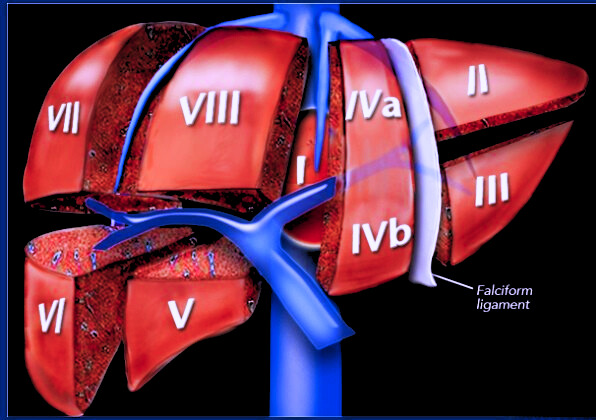
Couinaud Liver Segmentation Diagram showing functional segments
Fig 1. The Couinaud classification divides the liver into 8 functional segments, allowing for precise anatomical resection.

Surgical Approaches Available

Robotic Hepatectomy (Da Vinci)

The Gold Standard for complex cases.

  • 3D High-Def Vision
  • 7-Degree Wrist Movement
  • Minimal Blood Loss
  • Fastest Recovery

Laparoscopic (Keyhole)

Ideal for smaller, peripheral tumors.

  • Tiny Incisions
  • Less Pain vs Open
  • Reduced Hospital Stay
  • Cost Effective

Open Surgery

Reserved for massive tumors.

  • For Tumors >10cm
  • Vascular Reconstruction
  • Complex Anatomy
  • Longer Recovery

The Recovery Roadmap

Recovery is a structured process. Dr. Srinivas and his team follow "ERAS" (Enhanced Recovery After Surgery) protocols to get you back on your feet quickly.

  • Day 0 (Surgery Day): Surgery takes 4-6 hours. You will wake up in the ICU for close monitoring. Pain is managed via Epidural or PCA pump.
  • Day 1-2 (Mobilization): You will be encouraged to sit up and take a few steps. Liquids are started orally. Drains are monitored.
  • Day 3-4 (Diet & Ward): Shifted to the ward. Soft diet begins. Drains are usually removed if output is low.
  • Day 5-7 (Discharge): Most patients are ready to go home. You will be walking independently and eating normal food.

Frequently Asked Questions

Yes, absolutely. The liver is remarkable. Even if we remove up to 60-70% of it, the remaining healthy tissue starts regenerating immediately. It usually returns to its normal functional volume within 3 to 6 months. This process is called "hypertrophy."
Any major surgery carries risk, but liver surgery has become extremely safe in specialized centers. Dr. Srinivas uses CT Volumetry before surgery to calculate exactly how much liver will remain, ensuring there is enough to keep you healthy. The mortality risk is typically less than 2% in experienced hands.
If the cancer is localized but the rest of the liver is severely cirrhotic (scarred) and failing, a resection might be too dangerous because the liver cannot regenerate well. In such cases, a Liver Transplant is the preferred option as it treats both the cancer and the underlying liver failure simultaneously.
Yes. You will start with liquids the day after surgery and move to soft foods by Day 2 or 3. Once you recover, there are usually no long-term dietary restrictions, although a healthy, alcohol-free lifestyle is highly recommended to protect the regenerated liver.
The best prevention is managing the risk factors: getting vaccinated for Hepatitis B, treating Hepatitis C with modern antivirals, and maintaining a healthy weight to prevent Non-Alcoholic Fatty Liver Disease (NASH). For those with known cirrhosis, regular ultrasound screenings every 6 months are vital for early detection.

Robotic Precision

Dr. Srinivas uses the 4th Gen Da Vinci Xi system for minimal scarring, less pain, and faster healing.

Learn about Robotics