
Colon Cancer Treatment & Robotic Surgery
Early detection leads to cure. Colon cancer is increasingly common in urban Bangalore due to lifestyle shifts. Dr. Srinivas Bojanapu combines Robotic Precision with Oncological Rigor (D3 Lymphadenectomy) to ensure complete tumor removal while preserving bowel function and getting you back to life faster.
Silent Signals: When to Consult?
Colon cancer often starts silently as a small Polyp (a wart-like growth). Over time, it can turn malignant. Do not ignore these "Red Flag" symptoms:
⚠️ The Warning Signs
- Anemia: Unexplained low hemoglobin or fatigue (Common in Right Colon Cancer).
- Change in Habits: New onset constipation or diarrhea lasting > 2 weeks.
- Visible Blood: Dark or bright red blood in stools.
- Abdominal Pain: Persistent cramping or bloating.
The Diagnostic Protocol
We rely on evidence-based staging before touching the patient:
- Colonoscopy: To visualize the tumor and take a biopsy.
- CEA Levels: A blood marker to track cancer activity.
- CT/PET Scan: To check if the cancer has spread to the liver or lungs.
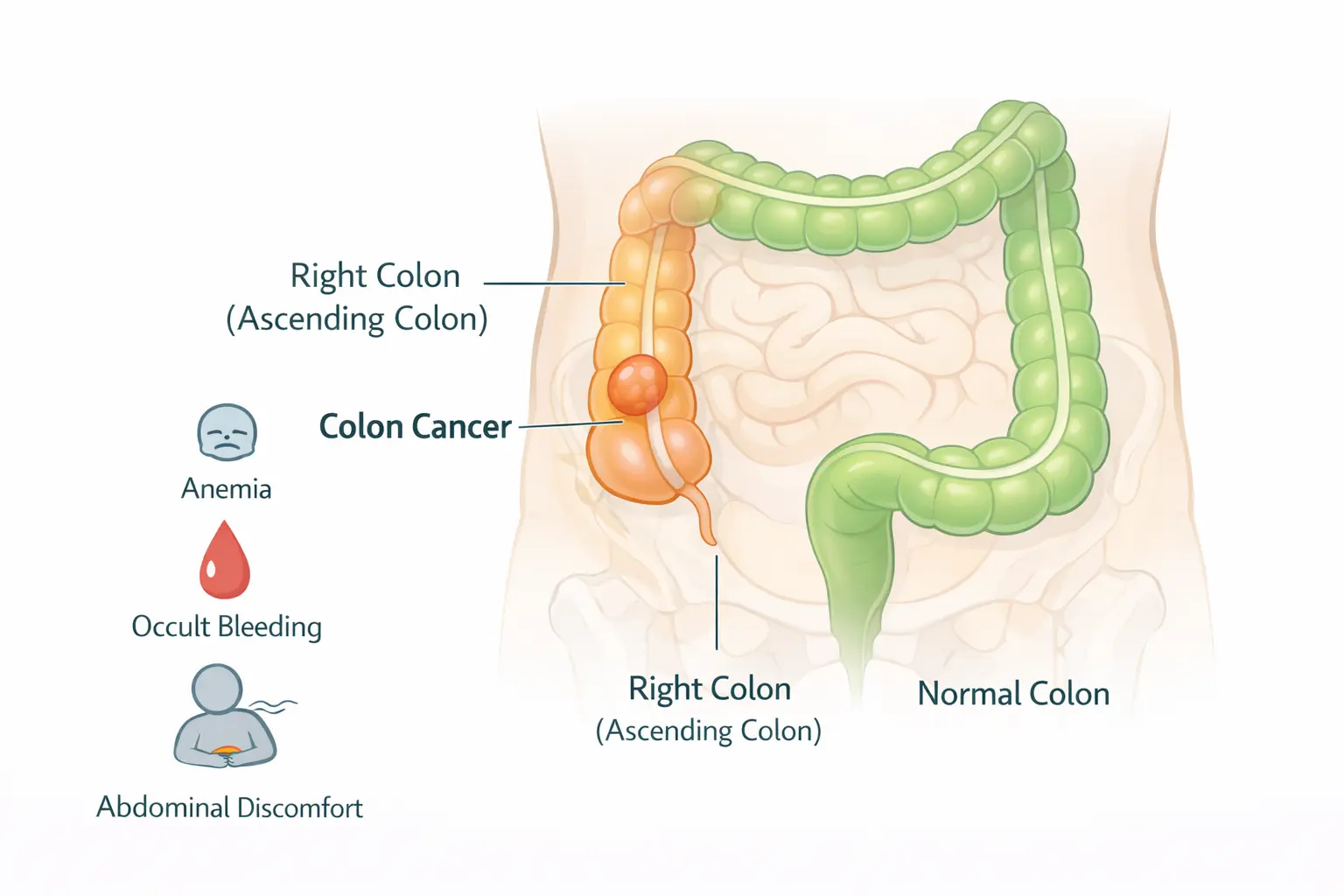
Note on "Silent" Tumors: Tumors on the right side of the colon (Cecum/Ascending Colon) often grow large without blocking the bowel because the stool is liquid there. The only sign might be unexplained anemia or fatigue. This is why we urge patients over 45 with low hemoglobin to get a colonoscopy.
Robotic Colectomy: The Gold Standard
Surgery is the mainstay of cure. Our goal is "R0 Resection"—removing the tumor with a healthy margin of tissue and all associated lymph nodes. Using the Da Vinci Xi Robot, we can perform these complex surgeries through tiny incisions.
Types of Surgeries We Perform:
- Right Hemicolectomy: For tumors in the cecum or ascending colon. We remove the right side of the colon and join the small intestine to the remaining colon (Anastomosis).
- Left Hemicolectomy: For tumors in the descending colon. This involves removing the left portion of the colon.
- Sigmoid Colectomy: Removing the S-shaped part of the colon just above the rectum. This is the most common site for colon cancer.
- Total Colectomy: In rare cases (like FAP or multiple tumors), we may need to remove the entire colon and connect the small intestine to the rectum.
Why Robotics over Open Surgery?
While traditional open surgery involves a large incision (15-20cm) and significant recovery time, Robotic Surgery allows us to operate with extreme precision. The robotic arms filter out hand tremors and provide 3D vision, which is critical when working around major blood vessels.
| Feature | Traditional Open Surgery | Robotic / Laparoscopic Surgery |
|---|---|---|
| Incision Size | Large (15-20 cm) cut | Tiny (8mm) keyholes |
| Pain Levels | High (Requires strong painkillers) | Minimal (Oral painkillers suffice) |
| Blood Loss | Moderate | Negligible (Precise vessel sealing) |
| Hospital Stay | 7-10 Days | 3-4 Days (ERAS Protocol) |
| Lymph Node Yield | Variable | High (Better Oncological Clearance) |
ERAS: Fast-Track Recovery
Gone are the days of lying in bed for a week. We utilize Enhanced Recovery After Surgery (ERAS) protocols to get you back to normal life swiftly. This modern approach reduces complications and shortens hospital stay.
Liquids on Day 1. Soft food by Day 3.
Mobilization starts 6 hours after surgery.
Opioid-free anesthesia avoids drowsiness.
Post-Discharge Care: Once home, you will be able to perform daily activities. We advise avoiding heavy lifting for 4 weeks. Regular follow-up with CEA levels and annual CT scans ensures we catch any issues early.